PAVEL BÜCHLER Experience
14.11 – 20.12.2025
PAVEL BÜCHLER
Experience
14.11.2025 – 20.12.2025
Tommy Simoens is pleased to present Experience, Pavel Büchler’s third exhibition with the gallery and his first at our new location on Antwerp North. Bringing together works made between 1999 and 2025, the exhibition offers a measured meditation on sound, duration, labour, and time — on the everyday behavioural loops that sustain the artist’s practice.
Across four decades, Büchler has pursued a singular investigation into the subtle intersections of listening, language and material memory. The works in this exhibition stand, as it were, in the precise overlap between Samuel Beckett and John Cage – between endurance and attention, silence and chance. If Beckett and Cage transformed absence into experience, Büchler offers its home-recorded version: the modest, imperfect and deeply human texture of nothing happening.
“There is really nothing creative in it,” he once remarked, “and yet it is the catalyst of creative production.” His work begins where productivity ends – in the quiet persistence of doing, recording, rearranging, and waiting.
In Table ↔ Turntable (1984–2025), Büchler charts the changing positions of his desk and record player in every studio he has occupied, from Cambridge to Manchester. The six superimposed drawings, printed in distinct colour versions, read like a cross between architectural plans and musical notation. They translate the modest routines of daily work into a visual score, where thinking and repetition become indistinguishable.
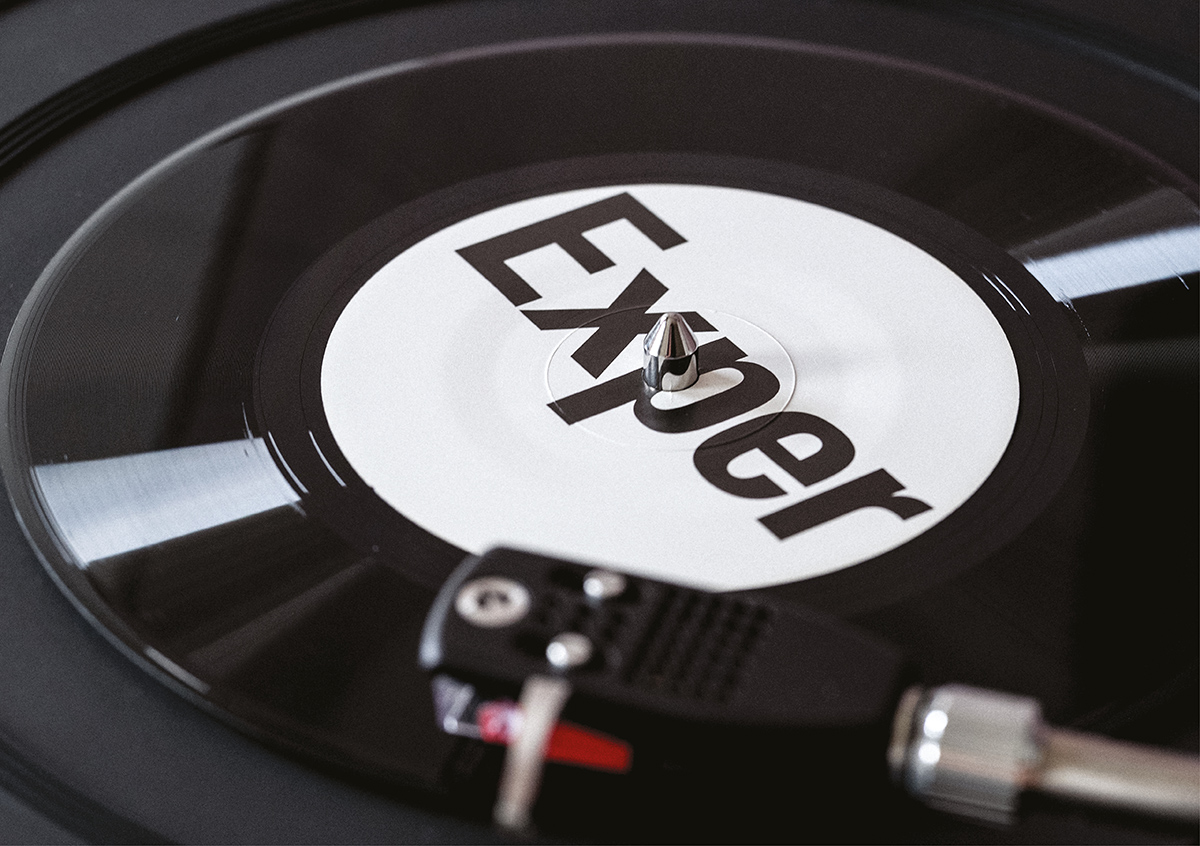
The new work Experience (2024) returns to the artist’s formative years in 1970s Prague, when contraband Western music circulated through bootleg tapes. Among those recordings was Jimi Hendrix’s Hey Joe – endlessly copied from a single smuggled record until its hiss and crackle became part of a generation’s collective memory. Büchler revisits this sonic imprint by removing the song itself, leaving only the noise of the original vinyl’s surface.
In 3’34” (2006), Büchler collects the lead-in grooves from ten John Cage LPs, combining them into a single record. The result is a composition of inframince sound – a texture of dust, static and near-silence marking the threshold between listening and waiting. The piece, as Craig Dworkin observed, is “a nearly perfect gesture”: a portrait of attention that turns deterioration into form.
The relationship between sound and its absence recurs throughout the exhibition. In Lou Reed Live (2007), a reel-to-reel tape loops the prelude to Reed’s Take No Prisoners – a match struck, a drag of breath, a brief “hello.” The microphone, connected in reverse, becomes a speaker. Presence gives way to playback; the concert never begins. LIVE (1999) and ENCORE (2005) extend this meditation on anticipation, collaging audience applause from various live recordings into uninterrupted waves of expectation.
Another crucial work to the exhibition, The Score (2008), presents a typed grid of time-codes concluding at 4’33”. The piece translates Cage’s silent composition into a written, second-by-second script. Much has been written about this work, including how the rhythm of the keystrokes and the bell at the end of each line might replace the audience’s experience during David Tudor’s original performance – transforming listening into writing. However, the title of the work – The Score – also indicates, perhaps ironically, a state of Cage’s work before it was ever executed, as a score. That said, it is nearly impossible, even for experienced typists, to “perform” this in the timing the piece implies, paradoxically heightening the awareness of what 4’33” of mental silence actually means – at least for the one who executed “The Score”.
Similarly, Beckett’s Cage (2019) transforms language into space: two letterpress prints divided by a deliberate gap, containing the phrase “a pause, more or less long.” The wall performs that pause, uniting Beckett’s syntax and Cage’s duration in a single visual empty space.
White Label (2003) projects the abstract geometry of a vinyl record as a circle of light – a study in playback reduced to pure image. 12:00:00 – 12:04:33, 17 October 2008 (2008) halts a stopwatch at Cage’s canonical duration during the recording of a live lathe cutting, suspending measurement in self-reference.
As an outlier, a diptych of reclaimed paint on canvas titled Veterans (2021) shows another form of repetitive labour. Büchler painstakingly removes the paint from found canvases, grinds it, and meticulously redistributes the residue until an originally failed painting “fails better.”
And finally, TONIGHT (2003) enlarges a found street sticker into a poster whose worn exclamation has already lost its urgency – an echo of a promise of a live experience that never arrives.
About Pavel Büchler
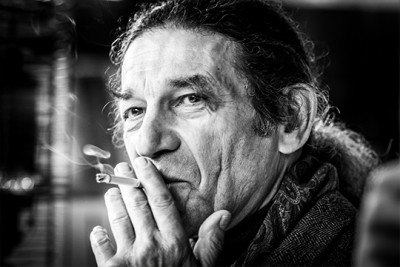
Pavel Büchler (b. 1952, Prague; lives in Manchester) is a Czech-British conceptual artist, writer, and educator, often describing his practice as “making nothing happen.” After leaving Czechoslovakia in 1981, he became a key figure in UK conceptual art, co-founding the Cambridge Darkroom gallery and later leading the School of Fine Art at Glasgow School of Art. His installations, text works and re-purposed everyday objects uncover the uncanny in the ordinary. Notable works include the ongoing series Work (All the cigarette breaks…) (2008–), exhibited in its most recent iteration at Gallery of Fine Art Cheb. Recent solo shows include Signs of Life (Cheb, 2024; Brno, 2023), Level (Florence, 2022) and New Paintings (Tommy Simoens, Antwerp, 2018). Group exhibitions include the Lyon Biennale (2024), Transmediale (Berlin), MuHKA (Antwerp), and DOX (Prague). Awards include the Northern Art Prize (2010) and the Paul Hamlyn Foundation Award (2012). His work is in public collections including Tate, MoMA, Arts Council England, and the National Gallery Prague.